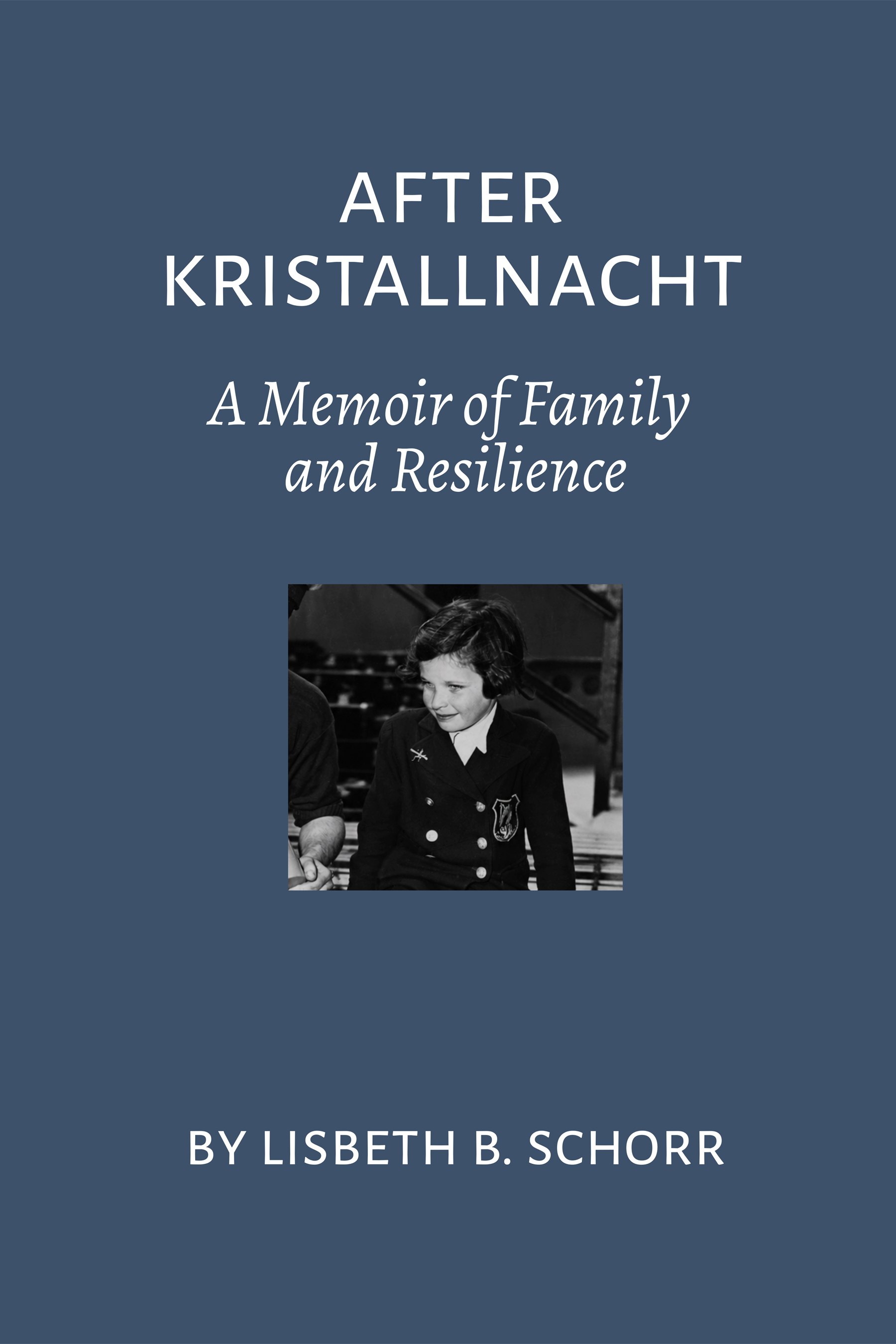
After Kristallnacht: A Memoir of Family and Resilience
By Lisbeth B. Schorr
On the morning after Kristallnacht, seven-year-old Li Bamberger left her home in Munich, three days after her father had been arrested and sent to Dachau. Li and her brother were hurried across Europe to safety, while their parents struggled to escape Nazi Germany before it was too late.
Drawing on an extraordinary collection of family memoirs, letters, official documents, and decades of historical research, After Kristallnacht tells the remarkable story of one extended Jewish family whose lives were forever transformed by the events of November 1938. Their experiences unfold alongside those of relatives, friends, and fellow refugees from Munich, Frankfurt, Leipzig, and Vienna, revealing both the terrifying immediacy of Nazi persecution and the courage, resilience, and generosity that made survival possible.
But this is more than one family’s story. Placing personal memories within the broader history of the Holocaust, the book explores the Kindertransport, daring rescue efforts, acts of resistance, the moral choices of diplomats and ordinary citizens, and the policies that resulted in the staggering loss of life among the Jews of Eastern Europe. Throughout, the lives of individual men, women, and children illuminate the larger forces that reshaped Europe and much of the rest of the world.
At once a family memoir, a work of history, a horrifying picture of Hitler’s horrors and a tribute to those who chose humanity over indifference, After Kristallnacht preserves the voices of a generation that is rapidly disappearing while reminding us that history is ultimately lived one family, one decision, and one act of courage at a time.
I was seven years old when, on November 12, 1938, two days after Kristallnacht, my brother, Klaus, who was 11, and I left our home in Munich, Germany, for England, via Switzerland and France. My mother had persuaded the English consul in Munich and his wife, acquaintances of my parents, to take my brother and me as far as Zurich. My mother also enlisted several relatives to take charge of us for the next few days until we arrived in England. Our parents were not able to leave Germany until several months later. We were reunited in England on April 9, 1939. Thus, my immediate family were among the minority of Jews who were able to leave Europe before Hitler’s plans turned from the expulsion of Jews to their extinction.
My father and two of my uncles were arrested on Kristallnacht. My father was the youngest of seven Bamberger siblings, and the only one of the seven who made it out of Germany alive. Amazingly, every one of the twelve children of the Bamberger siblings got out of Germany in time. As of this writing, I’m the youngest of that generation in my family, and the only one still alive to put together what we know and tell the tale. I wanted to be sure that my children’s and grandchildren’s generation could have access to the story of this vast, complicated, and sometimes heroic family.
Fortunately, several family members recorded their memories in eloquent written form, including my mother, who left a rich and deeply researched memoir. Many also saved correspondence and other documents with valuable information. Putting those materials together with what surviving family members could remember and were willing to share, became more deeply meaningful as I was able to delve into the context to be found in the writings of other observers and historians.
As I learned more—and this part, I’m chagrined to say, was quite new to me—I discovered how fundamentally different the impact of the Nazi horrors were on the populations that were most familiar to me—the Jews who had started out in Germany, Austria, and Czechoslovakia—compared to the Jews who came from Poland and other countries of Eastern Europe and Russia. I had thought, quite erroneously as it turned out, that the story of my immediate family pretty much represented the story of Europe’s Jews from 1933 until soon after World War II. I had failed to understand some fundamental facts, such as that the six million Jews who perished in the Holocaust included not just 30 percent of Germany’s Jews, but 90 percent of Poland’s Jews.
I am hoping that my efforts to tell my family’s story and put it into the context of a broader history of that time will be useful to a variety of readers as well as to my children and grandchildren, our many other surviving relatives, and a wide array of friends.
- Lisbeth B. Schorr