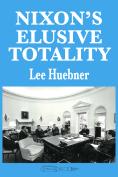
Nixon’s Elusive Totality: It Depends on Who Writes the History
By Lee Huebner
“Nixon’s Evasive Totality. It depends on Who Writes the History” is a new look at Richard Nixon, one of the most controversial leaders in U.S. history.
Author Lee Huebner was a White House speechwriter for President Nixon, and has taught a university course about him for 25 years. He seeks in this book to look at Nixon “in his “totality” –as President Bill Clinton urged the country to do at Nixon’s funeral. Huebner argues that both Nixon’s critics and his defenders have missed out on this full story, as he traces in some detail the roots of the man’s complexity, from his difficult childhood through his final Watergate crisis in 1973 and 1974, during which, as Nixon himself later put it, “I did myself in.”
Nixon had dominated the U.S. political stage since 1948, when his lead role in the controversial Alger Hiss case established his reputation as a leading anti-communist crusader. His negative campaigning style in races for the U.S. House and Senate, and then for the vice-presidency in 1952 also gave him a reputation with many critics as a “hatchet man” and “smear artist.” His televised “Checkers Speech” (which saved his career in 1952 by defending himself against false charges of campaign fund misuse), attracted what the was then the largest audience to gather for one event in human history, as did his series of televised presidential campaign debates in 1960 with John F. Kennedy. He became one of only two people to appear five times on a national presidential ballot, serving for eight years as vice-president under President Eisenhower and later for five years as a pathbreaking president. His historic trips to China and then to the Soviet Union in 1972 preceded his record setting re-election victory that Fall.
But then came Watergate.
On his last night in office before his resignation (now over a half century ago) he was assured by his close aide, Henry Kissinger, that history would remember him better than would his contemporaries. Nixon’s s response serves as the subtitle of this book: “It depends on who writes the history.”
Why Study Nixon?
This book grows out of nine years of personal interaction with Richard Nixon, including five years as a White House speechwriter. It also reflects some 25 years of teaching a college course focused on Nixon—first at Northwestern University and then at the George Washington University. The book, like the course, takes up centrally the initial question I have been asking my students through the years, “Why Study Nixon?”
The question reflects my own curiosity (shared by many others) as to why this course should consistently be over-enrolled even a half century after Nixon’s resignation as President? (It’s as if I had signed up when I was in college for a class about William Howard Taft!)
The students’ responses talk about contradictions in what they have heard about Nixon, from parents and grandparents and teachers, journalists and other writers, documentaries and even comedy tv shows. In response, I suggest that those basic contradictions can be found within Nixon himself. In fact, the central lesson of the course, as I see it, is that people are complicated, politics are complicated, and life is complicated. And we should thus avoid being trapped by stereotypes and over-simplifications, not only in considering historical matters but also in our approach to current issues and personalities. My hope, in short, is that the course (like this book) will underscore the importance of critical thinking—a readiness to explore, analyze and evaluate a representative range of relevant information.
Of course, there are a number of other fascinating dimensions to the Nixon story. Perhaps most importantly, he was a dominating figure on the national scene from his first Congressional election victory in 1946 though his resignation from the Presidency in 1974—and even afterward, as he published some 10 books during the final two decades of his life. His public career spanned the whole of the Cold War—from “Yalta to Yeltsin.” Meg Greenfield of the Washington Post famously once mused that she was part of a “Nixon generation,” one that lasted a half -century. She was too young to remember a time when Nixon was not in the nation’s headlines, and too old to foresee a time in which he would not still be prominent. During his career, he became one of only two people to have appeared five times on national election tickets—three times as a presidential candidate and twice as the vice-presidential nominee (FDR was the only other five-time nominee).
Nixon’s was not necessarily a dominant voice throughout this period—and in fact he was often at his most effective when he was fighting back after serious reversals. And his indeed was a roller-coaster career, beginning with his emergence as a controversial anti-communist crusader in the 1940s and continuing– during his first Congressional term in 1948—with his leadership role in the era-defining Alger Hiss case. His ascent continued with his election to the US Senate in 1950 and then his nomination as Dwight Eisenhower’s vice-presidential running-mate in 1952. That success was quickly followed by his near dismissal from the ticket amid false allegations of financial scandal, and then his recovery following his era-defining Checkers speech—the very first nationally televised political speech.
Nixon’s extremely narrow loss in the 1960 presidential race against John Kennedy (which he did not contest although many of his followers (and some independent journalists) felt that he had cause to do so), was quickly followed by the success of his self-defining book Six Crises, and then by his significant 1962 loss to Pat Brown for the governorship of California. His response to that defeat was his defiant “last press conference—”You won’t have Nixon to kick around anymore!” It ushered in what he came to call his “wilderness years”—which then ended with his successful presidential victory in 1968. His tumultuous first term in the White House was climaxed not only by his historic visits to both China and the Soviet Union in 1972—but finally by his record–setting victory margin, as he was re-elected with almost 61% of the popular vote and sweeping wins in 49 states.
But within months, a highly popular bumper-sticker was exclaiming: “Don’t blame me. I’m from Massachusetts” (the only state Nixon did not carry in 1972)—amid the unfolding explosions of the Watergate case.
- Lee Huebner